The First Ledger
№ — A history project

How trusted elders built the modern administrative machine.

It started with the village wise-man counting grain. It became birth certificates, taxes, central banks, and identity itself. This is the receipts — no sugarcoat, no pseudolaw, no living individuals named as targets.

Eight chapters31 sourced videos~3,300 BCE → present

Watch the 31-video library →

Watch first

How writing actually began — and why.

It wasn't poetry. It wasn't kings. It was barley and beer — owed to a temple. Sumer's first scribes were the original ledger-keepers.

The thesis in one sentence

The first record-keepers were trusted elders solving a real problem — who owed grain, who got married, who died. The same machinery, scaled over 5,000 years, is now a global identity-and-finance system that almost no one consents to but almost everyone is enrolled in at birth.

01
Chapter One

Sumer, Uruk, and the Kushim tablet.

Sumerian administrative tablet, c. 3100 BCE, recording allocation of beer rations
Sumerian administrative tablet, c. 3100 BCE, recording allocation of beer rations. British Museum / Wikimedia Commons. This is exactly the kind of tablet signed by Kushim, the oldest known named person in history — an accountant.

Around 3300 BCE in the city of Uruk, in what is now southern Iraq, temple administrators began pressing wedge-shaped marks into wet clay to track barley, beer, sheep, and labor owed to the temple. They were not kings. They were not soldiers. They were elders — literate priests trusted by the community to keep count.

The oldest known signed document in history is a tablet logging 29,086 measures of barley over 37 months, signed Kushim. Kushim was almost certainly an accountant. Writing began as bookkeeping.

Go deeper on Kushim

The full dedicated page on Kushim — who he (or she, or they) actually was, what the 29,086 measures of barley actually mean, where the surviving tablets live now, and 11 hand-picked videos.

Open the Kushim page →

Sources. British Museum tablet collection · Schmandt-Besserat, How Writing Came About (1996) · Harari, Sapiens Ch. 7.
02
Chapter Two

Rome, the census, and the legal person.

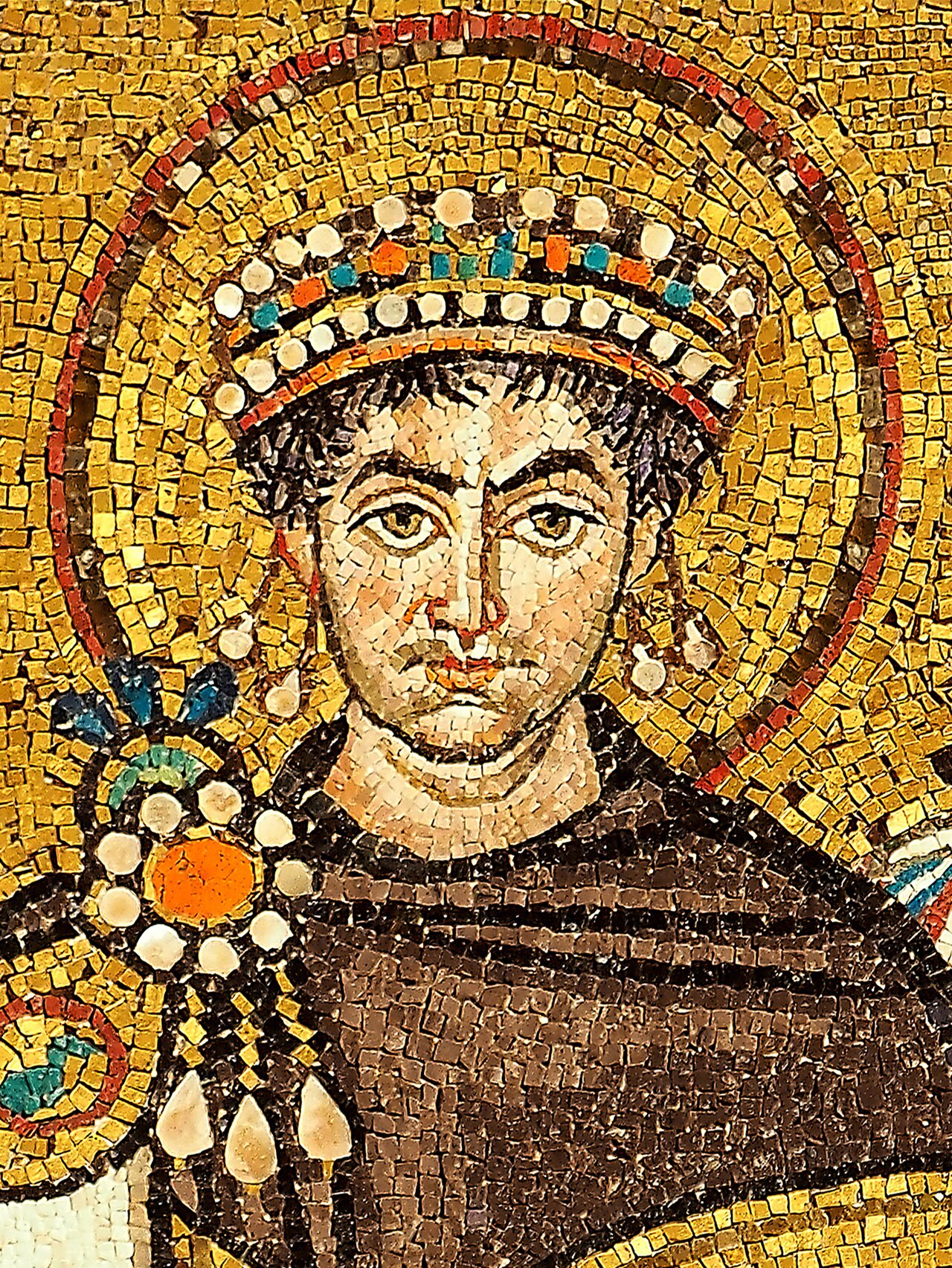
Mosaic of Justinian I, Basilica of San Vitale, Ravenna, c. 547 CE
Mosaic of Justinian I, Basilica of San Vitale, Ravenna, c. 547 CE. Justinian's Corpus Juris Civilis (529 CE) became the spine of European civil law and the source of the modern concept of legal personhood.

Rome turned ledger-keeping into a system of state. The census (literally to assess) counted every free male every five years for tax and military service. To be counted, you had to have a legal status — persona, Latin for the mask an actor wore on stage. The word survives in personhood, personal, and personnel.

This is where the modern fiction begins: the state recognizes the persona, not the breathing human. The persona can own property, owe tax, and be enrolled in obligations. It was useful — without it, contracts and inheritance fall apart. It was also the first time a human being's identity was something stored on a register outside their body.

Sources. Justinian, Institutes Book I · Livy, Ab Urbe Condita · Mommsen, Römisches Staatsrecht.

03
Chapter Three

The Domesday Book (1086).

Page from the Domesday Book, English counties survey, 1086
Page from the Domesday Book, English counties survey, 1086. The National Archives (UK) via Wikimedia Commons. Contemporaries called it Doomsday because there was no escape — every manor, plough, mill, pig and serf was written down.

Twenty years after the Norman Conquest, William I sent commissioners across England to record every manor, plough, mill, pig, and serf. The survey was so thorough that contemporaries said there was no escape — like the biblical Day of Judgement. Hence: Doomsday → Domesday.

This is the moment a Western state stopped trusting elders' memory and demanded everything be written down — and the moment the written record became proof, not the elder's word.

Sources. Anglo-Saxon Chronicle 1085 · The National Archives DB online · Hallam, Domesday Book Through Nine Centuries.

04
Chapter Four

Parish registers and Thomas Cromwell (1538).

Portrait of Thomas Cromwell, after Hans Holbein the Younger
Portrait of Thomas Cromwell, after Hans Holbein the Younger. National Portrait Gallery / Wikimedia Commons. Cromwell's 1538 Injunctions made the parish priest the official record-keeper of every birth, marriage, and death in England.
The first parish register of St. George of Tombland, Norwich (A.D. 1538–1707)
The first parish register of St. George of Tombland, Norwich (A.D. 1538–1707). Reproduction from the 1891 edition, Wikimedia Commons. This is exactly the kind of book Cromwell's injunction created.

In 1538, Henry VIII's chief minister Thomas Cromwell ordered every parish in England to keep a book recording every baptism, marriage, and burial. This was the first standardized, nationwide vital-records system in the English-speaking world. The keeper was the local priest — a trusted elder.

That parish register is the direct ancestor of your birth certificate. The trust didn't disappear; it migrated. From the elder, to the priest, to the parish, to the registrar, to the state, to the database.

Sources. Cromwell's Injunctions of 1538 · UK National Archives parish register guide.

05
Chapter Five

The 1836 Births and Deaths Registration Act.

By the 1830s, industrial cities had outgrown the parish. Methodists, Catholics, Jews, and the unchurched were falling through the cracks. In 1836, Parliament passed an act that took registration of births, marriages, and deaths away from the church and gave it to a civil Registrar General — a government office.

The modern birth certificate, as a state-issued document tied to a state-issued number, traces directly to this act. The same model spread through the British Empire, Europe, the Americas, and eventually almost everywhere.

The state did not steal your identity at birth. It inherited the parish priest's job — and then it never gave it back.

Sources. Births and Deaths Registration Act 1836 (6 & 7 Will. IV c. 86) · UK ONS history of civil registration.

06
Chapter Six

The rise of the Vicar of Christ.

Medieval reused papal bulla of Pope Boniface VIII
Medieval reused papal bulla of Pope Boniface VIII. Portable Antiquities Scheme / Wikimedia Commons. Boniface VIII's bull Unam Sanctam (1302) declared submission to the Roman Pontiff absolutely necessary for salvation for every human being.

Parallel to the secular ledger, a religious one grew. In 1075, Pope Gregory VII's Dictatus Papae claimed the pope could depose emperors. In 1302, Boniface VIII's Unam Sanctam declared submission to the Roman Pontiff absolutely necessary for salvation for every human being. The title Vicar of Christ — Christ's stand-in on earth — became standard.

For the first time, one office claimed authority over every soul, baptized or not. The mechanism was again a register: the baptismal book. The trusted elder had become an infrastructure for spiritual jurisdiction across continents.

Sources. Gregory VII, Dictatus Papae (1075) · Boniface VIII, Unam Sanctam (1302) · Tierney, The Crisis of Church and State, 1050–1300.

07
Chapter Seven

The Doctrine of Discovery and the papal bulls.

In 1452, Dum Diversas; in 1455, Romanus Pontifex; in 1493, Inter Caetera. Three papal bulls authorized Catholic kingdoms to invade, search out, capture, vanquish, and subdue all Saracens and pagans and to reduce their persons to perpetual slavery, and granted Spain and Portugal sovereignty over any discovered lands not held by a Christian prince.

The U.S. Supreme Court used this framework explicitly in Johnson v. M'Intosh (1823) to deny indigenous title to land. The Doctrine of Discovery has never been formally rescinded as law in most jurisdictions, even after the Vatican's March 2023 statement repudiating it morally.

This is the hinge of the whole story: the ledger that began as trust between an elder and his village was, by 1493, being used to license the seizure of two continents.

Sources. Dum Diversas · Romanus Pontifex · Inter Caetera · Johnson v. M'Intosh 21 U.S. 543 (1823) · Vatican statement, 30 March 2023.

08
Chapter Eight

Why pseudolaw fails — and what's actually true.

Important. This site does not endorse sovereign citizen, freeman on the land, Cestui Que Vie hidden trust, all-caps strawman, UCC redemption, or A4V bond theories. They are not real law. Every court in the United States, United Kingdom, Canada, Australia, and New Zealand has rejected them. People who try to use them in court lose, get fined, and sometimes get jailed. If you are facing a legal problem, hire a licensed lawyer or go to legal aid.

What is true is more uncomfortable than the conspiracy version: there is no hidden trust with your name on it. There is, however, an administrative system five thousand years old that was built by ordinary trusted people doing ordinary useful work, that gradually fused with state power, religious authority, and finance, and that you are enrolled in from your first breath without ever being asked.

You can criticize that. You can want it reformed. You can study it. You cannot escape it by writing your name in red ink and claiming you are not the all-caps version of yourself.

The honest path is the harder one: read the receipts. Learn the actual history. Vote, organize, sue, write, build alternatives. The elders' machine got here through five millennia of small, deliberate steps. Changing it will take the same.

Where to go next

Keep reading. Keep watching. Send better sources.

Watch the library

31 hand-verified videos from TED-Ed, the Royal Institution, the British Museum, Gresham College, World History Encyclopedia, and others — organized by chapter.

Open the videos →

Send a correction

Found a better source? Spotted an error? Have a primary document we should cite? Write in. We do not respond to threats or messages naming individuals as targets.

Send a note →